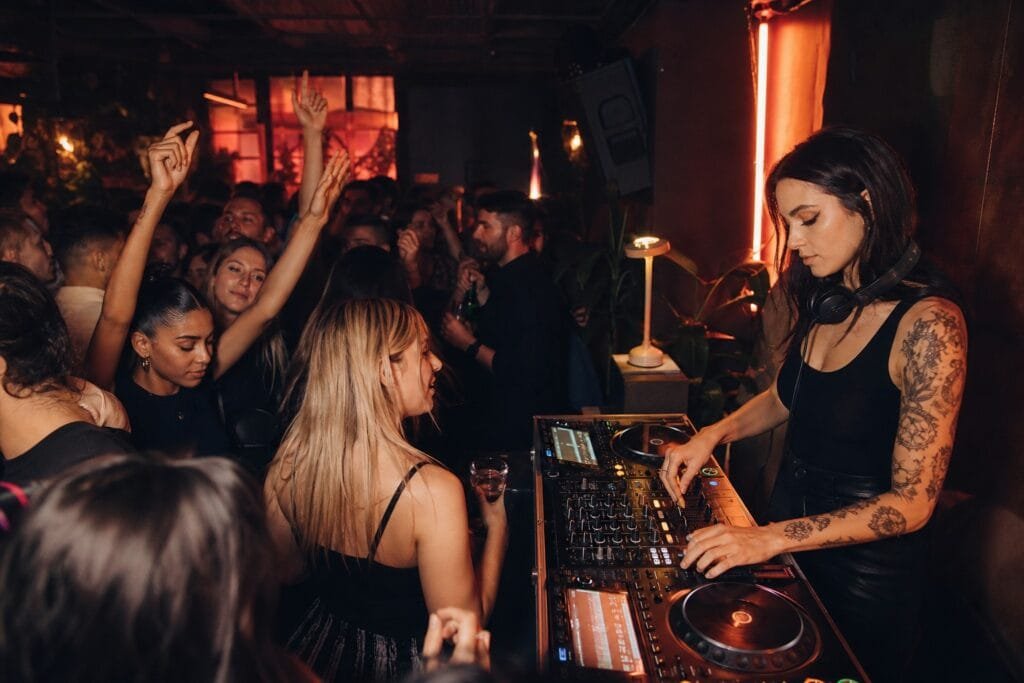
“How much is a DJ?” is the first question most venue operators ask us, and it is the wrong one. The fee is the visible part of the cost, and it is rarely the part that decides whether the night pays for itself.
So here is the whole number: every line of what a DJ night costs a London bar in 2026, what the licensing actually comes to (less than most operators fear), and the break-even maths on the back of it. All figures are from published sources, linked throughout.
Line 1: the DJ fee
Across the UK, a bar or pub DJ costs £150 to £400 a night, according to Smart Pub Tools’ 2026 analysis. In London specifically, a three to four hour bar or pub slot sits at £200 to £500, per the GigXchange London rate index.
Four things move a DJ inside that band:
- The night. A Thursday costs less than a Saturday, for the obvious reason.
- The hours. Most quotes assume three to four hours. A 7pm to 1am shift is a different job.
- Specialism. A genre specialist who can hold a specific crowd costs more than an open-format generalist, and is usually worth it if your room has an identity.
- Kit. A DJ bringing their own controller, speakers and booth is carrying equipment and van costs, and will price accordingly.
Worth knowing: wedding and corporate rates get quoted at £700 to £1,800 for a five hour set in London. Those numbers circulate widely and frighten operators unnecessarily. They are a different market with different expectations. A regular bar night is not priced like a wedding.
Line 2: music licensing, and why it is smaller than you think
This is where most operators either overestimate wildly or get caught out. Two separate things are going on, and they get confused constantly.
Do you need a licence from the council? Usually not. Under the Live Music Act exemption, an alcohol on-licensed premises can put on live music or a DJ between 8am and 11pm for an audience of up to 500 people without any additional entertainment licence, and restrictive conditions on your premises licence are suspended during that window (gov.uk). After 11pm is a different conversation.
Do you need TheMusicLicence? Yes, and you almost certainly already have one. This is the copyright licence from PPL PRS that covers playing recorded music in public at all, and it is separate from council licensing. Published 2026 examples: a pub or bar of 400 square metres or less playing music via radio pays £359.95 a year plus VAT, which PPL PRS presents as 98p a day (PPL PRS cost examples, updated February 2026).
The DJ-specific bit. A DJ set counts as Specially Featured Entertainment, which is charged on top of your background music licence. Under PPL’s 2026 SFE tariff, the fee is £1.41 for every hour of the event and for every 1 to 25 people attending (PPLPP299, effective 1 January 2026). PRS charges its own element on the same invoice.
Put a number on that. A four hour DJ set with 100 people in the room is four units of 25, across four hours: 4 × 4 × £1.41 = £22.56 for the PPL element of that night. Not nothing, but nowhere near enough to decide against running the night.
Line 3: equipment
Most working DJs bring their own controller and headphones. What they usually need from you is somewhere to stand, power, and a sound system that can handle four hours at volume.
You have two routes. Either the DJ brings a full rig, which is priced into a higher fee every single time you book, or you install a modest house setup once and it costs you nothing on night two onwards. If you intend to run music weekly, the house setup pays for itself quickly. If you are testing the idea, pay the supplement and find out whether the night works before you buy speakers.
One practical point: setup for a DJ is 30 minutes to an hour with a small footprint, against a band that needs dedicated space, a soundcheck and often a sound engineer at £100 to £150 on top (Smart Pub Tools). If your room is tight, that difference matters more than the fee does.
Line 4: the costs nobody quotes you
- Staffing. A busy DJ night usually needs one more person behind the bar. If the night works, this is the cost you want to have.
- Promotion. Not optional, and not a chalkboard. More on this below.
- Sound management. If you have residential neighbours, the cost is attention rather than money: door discipline, keeping windows shut after a certain hour, knowing where your limiter sits.
The break-even maths
At typical wet-led margins of 40 to 50 per cent, every pound of talent cost needs roughly two pounds of additional sales behind it.
| Talent cost | Extra wet sales needed to break even | Roughly |
|---|---|---|
| £250 DJ | £500 to £625 | 20 to 25 extra customers on three or four drinks |
| £400 DJ | £800 to £1,000 | 35 to 40 extra customers |
| £500 four-piece band | £1,000 to £1,250 | plus sound engineer, plus the space it takes |
The £500 band figure and the 40 to 50 per cent margin assumption come from Smart Pub Tools. The customer counts are our own arithmetic on a mid-range London drinks spend, so treat them as illustrative rather than gospel, and run them against your own average transaction value.
The important structural point: a DJ’s cost is fixed and does not scale with how well the night goes. If it overperforms, your talent cost stays exactly where it was. That makes DJ nights a cheap way to test a format before you commit to anything expensive.
Where the return actually comes from
Not the door. In most bars, the return is dwell time.
Rostar director Marland Barsby, speaking to The Morning Advertiser, puts it bluntly: most pubs lose people between 19:00 and 21:00, and music “keeps them in the pub for an extra two or three beers, which is an hour or more longer than usual”. CGA‘s research points the same way, with guests at music-led occasions staying longer, spending more and over-indexing on drinks spend against a standard visit.
Two or three extra drinks from each of the twenty people who would otherwise have left at nine o’clock is the entire economics of a DJ night, and it does not require a single new customer to walk through the door.
There is also a timing shift worth building into your thinking. NTIA and NIQ’s Market Monitor found in May 2026 that 28 per cent of consumers are going out earlier, and that the 5pm to 7pm slot now generates more revenue than 7pm to 10pm. Most operators still instinctively start their DJ at ten. On current consumer behaviour, seven is the better bet in a lot of rooms.
What separates a DJ night that pays from one that does not
Three things, and none of them are the fee.
Consistency. Barsby estimates only 15 to 20 per cent of pubs programme music well enough to see a commercial return, and the most common mistake is treating it as an occasional bolt-on. A night people can rely on being there every week builds a habit. One-off bookings scattered through the calendar do not.
The right sound for the room. A genre that suits a cocktail bar at seven is not the genre that suits a late Friday. This is where a booking goes wrong most often: the DJ is good and the fit is wrong.
The same face. A resident who learns your regulars, your peak times and what empties the room is worth more by week six than a rotating cast of strangers ever will be.
The short version
For a London bar in 2026, budget £200 to £500 for the DJ, around £20 to £30 in SFE licensing on a busy four hour night on top of the annual music licence you already hold, and one extra pair of hands behind the bar. Break-even is somewhere between twenty and forty extra covers, or the same regulars staying two hours longer.
That is a genuinely low bar to clear. What decides it is not the fee. It is whether the night is consistent, correctly programmed and starting at the right time.
If you are weighing up a regular music night for your venue, we place vetted, genre-matched DJs with bars and pubs across London and Greater London, on one-off bookings or ongoing residencies. Have a look at how resident DJ hire works, or tell us about your room and we will tell you honestly whether a DJ is the right call for it.
Free guide · 2026/27 season
Putting Music On: the venue operator’s guide
The licensing rules, the real PPL and PRS fees, and a break-even worksheet that is allowed to say no. Every figure linked to a primary source.